Building my first app with Claude Design & Claude Cowork
How a Forward Deployed Product Manager role at Fractional AI became Haute Resume — an AI résumé-tailoring app designed, prototyped, specified, built, and QA’d in one long conversation with Claude on its Fable 5 model. I never opened a code editor.
T
Theonic Way
AI Transformation Strategist & Product Builder
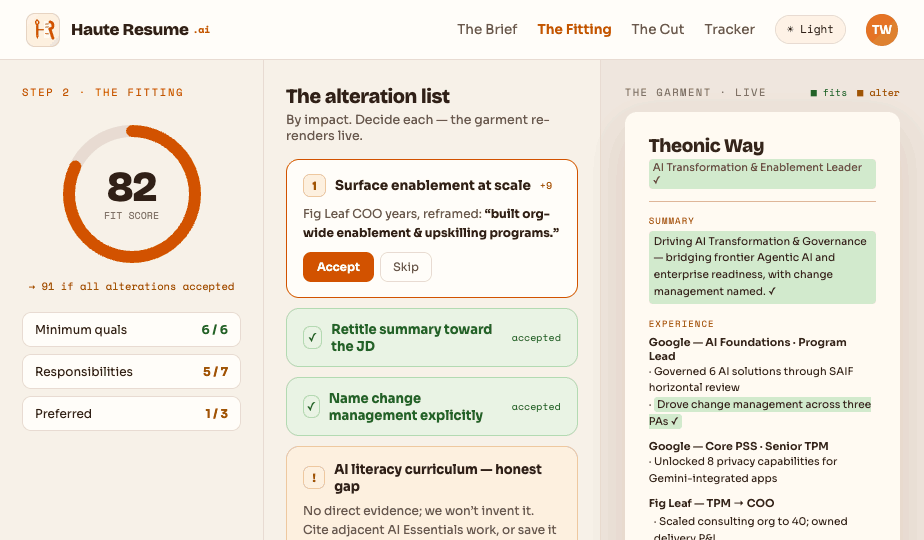
The Fitting · the core screen
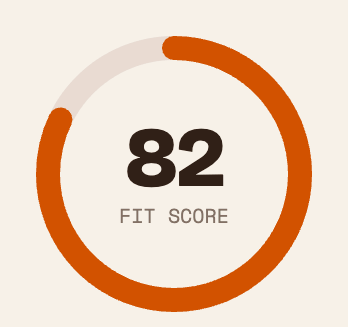
It starts as a number: 82.
Accept every honest alteration and it climbs to 91. One dial made the whole product legible at a glance — quantify the fit, then show exactly where it goes. So I led with it.
The fit-score dial — the single most legible “this works” moment in the app.
I stumbled onto it on Fractional AI’s home page: the announcement that a new AI-native enterprise services firm — led by Anthropic, Blackstone, and Hellman & Friedman, built to help companies bring Claude into their core operations — had acquired them as its founding team. And on their careers page: Forward Deployed Product Manager. A role about walking into a real business, finding where AI actually fits, and shipping the proof.
You don’t apply to a role like that with a résumé alone. You apply with evidence. So I picked a real problem from my own life — tailoring that résumé, over and over, for every application — and ran the full forward-deployed motion on it: discover, scope, design, spec, build, QA, ship. My product team was Claude, running on its Fable 5 model — Claude Design for the design partnership, Claude Cowork for the build. I worked the way I think best: out loud. I’d reason through a problem in the chat — why a fit-score dial beats a checklist, why an honest-gap card has to refuse rather than invent — and Claude reasoned alongside me, pushed back, and made the next move on top of that thread rather than starting cold. If the job is putting Claude to work inside real workflows, the audition should be exactly that, documented end to end.
The brief came first, in plain words
I gave Claude a paragraph, not a spec: read a job description from a URL or paste, compare it against my base résumé, find the gaps, produce an ATS-safe revision I can edit, export a PDF whose filename carries the date and time, keep a log of where I’ve applied. Claude asked the questions a good design partner asks — who’s it for, what device, how honest should the AI be about weak matches — and then we started naming.
The metaphor did the work
“Haute Resume” won the naming rounds because the tailoring metaphor kept paying rent: the job description becomes the brief, gap analysis the fitting, tracked changes the cut, export the press, the application log the wardrobe. A name that hands you the entire product vocabulary is doing real work — and the same metaphor drove the mark. It took the most iterations of anything: a monogram where the H’s left stem is a threaded needle, the crossbar a running stitch, and the right side an ivory résumé page whose edge completes the R. Eight rounds — thicker pages, orange bowls for contrast, sparkle experiments for the AI angle — before the version with a Space Mono .ai tag in the corner, matching the house grammar of the site you’re reading.
One drawing, two colorways — the dark badge installs to your home screen; the light one lives in the app’s light mode.
Three fittings, one honest winner
For the core screen — the gap analysis — Claude designed three genuinely different takes: a fitting room with the résumé as a garment on a form; a match report with a fit-score dial and a scoreboard of qualifications; and a pinned garment, the actual document with alteration pins stuck in it. I loved the dial the moment I saw it: it quantifies the fit at a glance, and “→ 91 if all alterations accepted” turns every decision into visible progress.
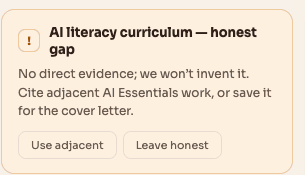
The choice wasn’t either/or. We merged the match report’s structure with the pinned garment’s document-visibility — the dial and prioritized alteration list on the left, my real résumé always on screen, re-rendering live with each accept. And one card mattered more than any other: the honest gap. When the job asks for something my résumé can’t evidence, the app says so and offers adjacent experience instead. An AI career tool that never fabricates isn’t a feature — it’s the whole point of trusting one.
“When the job asks for something your résumé can’t evidence, the app says so. No direct evidence; we won’t invent it.”
— the honest-gap card, the design decision I’m proudest of
The card itself — refuse, then offer an honest alternative.
The Fitting — my real résumé stays on screen, re-rendering live with each accepted alteration.
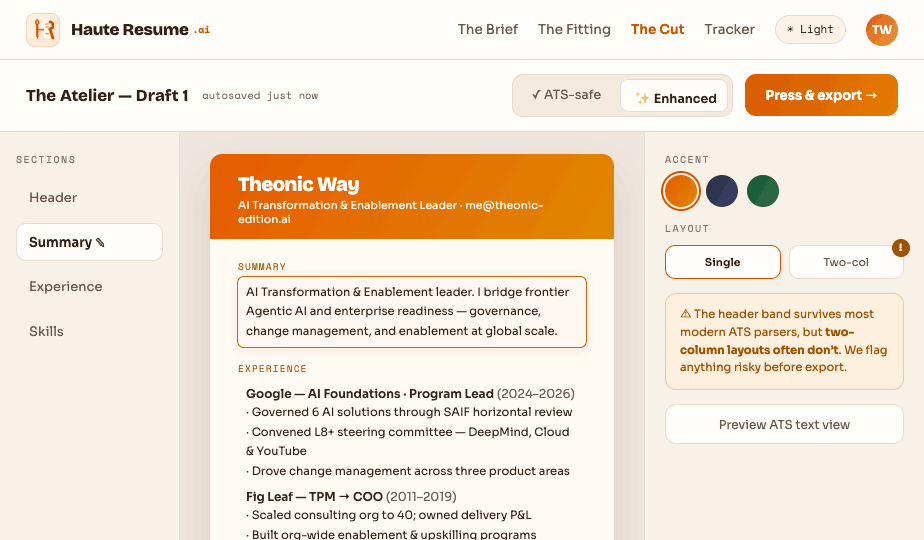
The Atelier — edit any section; ATS-safe by default, Enhanced mode unlocked with guardrails.
From mockups to a prototype that behaves
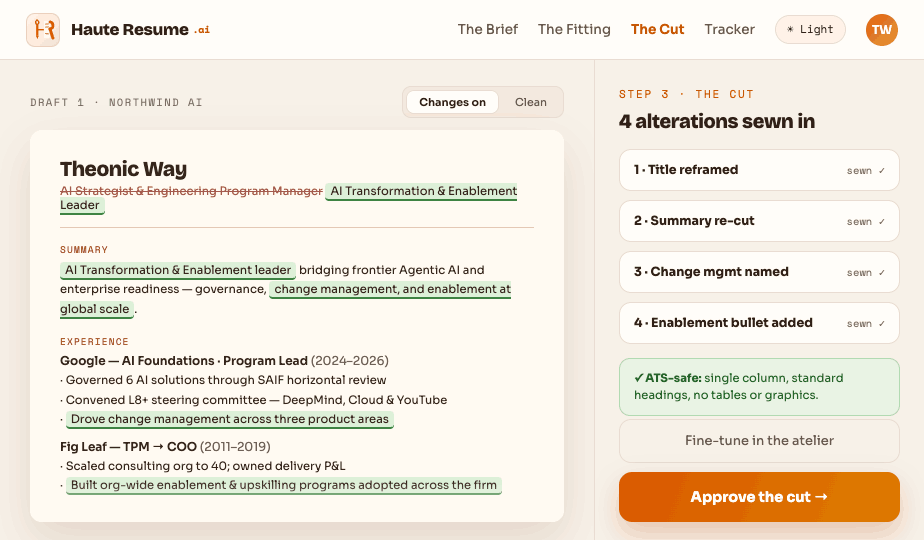
Every screen was explored in two or three variations — layout, voice, light and dark — and each decision was recorded with its rationale before moving on. Then Claude wired the winners into a single interactive prototype: the dial animates from 82 to 91 as you accept alterations, the tracked-changes view toggles to a clean read, the export filename composes itself with a live timestamp, and the settings sheet handles a bring-your-own-API-key flow so the public demo costs me nothing while the real app runs on my own key.
The Cut — tracked-changes grammar, per-change revert, ATS-safe check.
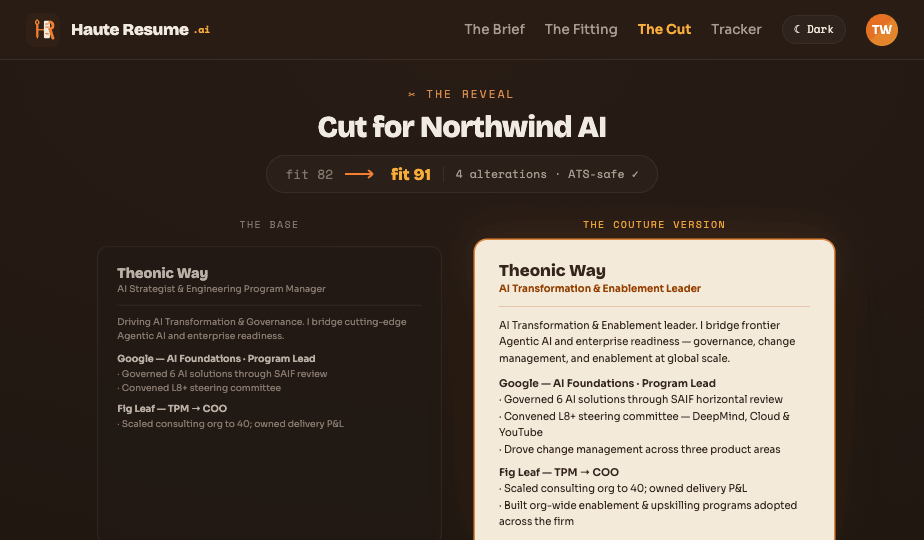
The Reveal — the couture version takes the light. Read-only, by design.
The handoff: one Markdown file, two AI collaborators
When the design settled, Claude Design wrote a build specification — screens, data model, on-device storage, the export pipeline, the AI-provider abstraction, an acceptance checklist — and I handed the folder to Claude Cowork. Cowork built the real PWA — service worker, IndexedDB, installability, the works — and I want to be precise about my role in that: I never opened the code, never touched an IDE, never wrote a line of it. I read the diffs the way a PM reads them, in plain language, and steered. The build happened in the conversation.
The part that sold me on Fable 5 was the self-QA loop. Cowork finished the build and then wrote a QA handoff back to Claude Design, which walked every screen against the prototype in both themes and returned a punch list — the model auditing its own work against the spec it was given, and finding things. It caught a real bug I’d never have spotted by eye: the PDF filename stamped local time while the tracker logged UTC — seven hours apart on the app’s signature feature. A frontier model that will hunt its own regressions changes what one person can ship.
That loop — design → spec → build → QA → fix — is the discipline I’ve run with human teams for fifteen years, except it took days and I never once stopped building to write documentation. The naming rounds, the logo iterations, the three fittings, the build spec, the QA punch list — none of it was written up after the fact. It was the fact. The conversation didn’t describe the work; it was the work, and it left a complete trail behind it. That’s forward-deployed product management with Claude on the team: the PM holds the problem, the decisions, and the quality bar; the model holds the pixels, the code, and a surprising share of the judgment.
The honest-gap card came from one sentence in my brief — “never fabricate” — and it became the app’s whole personality. Say what you value out loud, and the model builds it in.
Haute Resume now lives at haute-resume.theonic-edition.ai — free demo fitting included, running on my actual résumé. One app, one user, built in days — which is precisely the point. The forward-deployed job isn’t building platforms; it’s finding the workflow that hurts, proving what Claude can do about it, and shipping something real enough to change how the work gets done. Consider this the field demo.
THE ARTIFACT
Step into the fitting room.
Try the demo fitting — it runs entirely in your browser, on my actual résumé.